Superintendent walkthrough vs. monthly drone capture: what each one actually catches
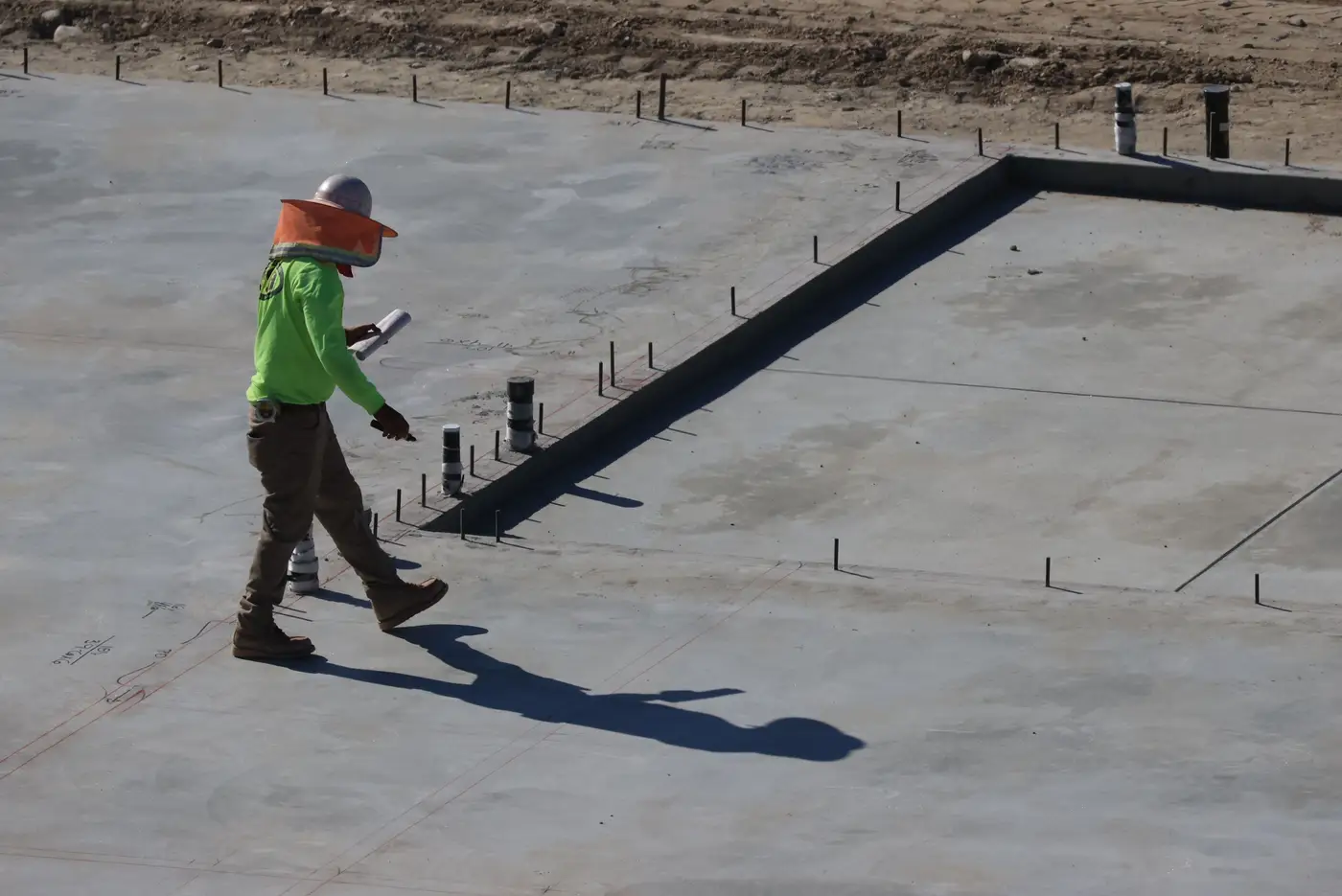
A superintendent doing a Friday walk and a drone flying the site on a monthly cadence are not checking the same thing, even though both get filed under "QA." One is a trained eye moving through the building at ground level. The other is a reconstructed surface sitting next to the design model. Mixing up what each one is good for is how a slab pour that's four inches off grade doesn't surface until the as-built survey at closeout.
What the walkthrough catches
A punch walk is built for finish work and installed-system checks: paint, trim, outlet placement, whether the mechanical room matches the submittal, whether a door swings the way the drawing says it should. The superintendent knows the sequence, knows which sub was on site last week, and can open a panel or run a hand along a seam. That's not something a photo from 200 feet up replaces.
What it's not built for is dimensional accuracy across a whole slab, a retaining wall run, or a grading pad. A person walking a pad with a tape measure and a level is sampling, a handful of shots at a handful of points, not every corner and every elevation change. If a wall is holding a lean that's inside what the eye reads as "straight" but outside the tolerance in the spec, the walkthrough passes it. The deviation doesn't show up until someone runs a total station on it, or until it's already poured over and the rework bill is a different number than it would've been last month.
What the monthly flight catches
The reconstructed surface from a drone pass works differently. It registers the whole captured area against the design model and flags where the built surface sits outside tolerance. That's grading pads checked for high and low spots across their full footprint, wall alignment drift measured over a run, and slab elevations checked at every point the capture reaches.
What it's not built for is finish detail or anything the camera can't resolve from altitude. GSD under 10 cm reads surface geometry and coarse elements well. It doesn't read whether an outlet is six inches off center or whether the trim coat matches the sample board. And because the flight runs monthly, it's a snapshot each time, not a live feed. Something built and covered over between flights is invisible until the next pass, if it's still visible then.
Where the gap costs money
The two checks fail in different directions. A walkthrough can miss a dimensional deviation because nobody measures every point. A monthly flight can miss it too, for a different reason: if the element gets backfilled, formed over, or finished before the next capture window, there's no surface left to register. That gap, the time between when something goes in and when either check looks at it, is where rework gets expensive instead of cheap.
The order of operations matters here. A manual QA walkthrough is reading detail and craft. A drone QA pass is reading geometry against the model, consistently, across the whole site, on the same schedule every time. Neither one replaces the other. A project that only does punch walks is blind to slow dimensional drift. A project that only flies monthly and never puts a boot on the ground is blind to everything the camera can't see.
If your team is already running one of these and wondering whether it's catching the deviations that matter, see how the comparison works and what a monthly pass flags against your model.
Catching a deviation while the rework is still cheap means knowing which check is supposed to find it, and running both before the concrete cures around the problem.